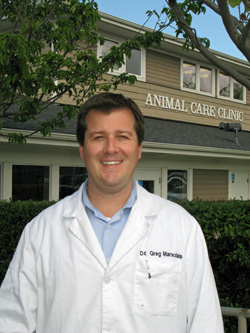
 We are privileged to have Dr. Greg Marsolais provide specialty surgical services at Animal Care Clinic. Dr. Marsolais started with us as a veterinary technician, in the mid 90’s, when we were still located on Granada Street. Greg graduated from California Polytechnic University in 1998, and then went on to graduate from Iowa State University with dual degrees of Master of Science in Veterinary Clinical Sciences and a Doctor of Veterinary Medicine in 2002. Dr. Marsolais also spent time as an intern at the Affiliated Veterinary Specialists in Florida before completing his surgical residency at the University of Illinois. Aside from completing research in canine rehabilitation, he has developed his skills and interests in orthopedic, neurologic, and soft tissue surgery. Dr. Marsolais currently resides in the Monterey Bay area, with his family.

Animal Care Clinic is the largest animal hospital located in San Luis Obispo, California. We care for small animals including dogs, cats, and pocket pets (rats, mice, rabbits, and guinea pigs). We take pride in our AAHA certification and having the only ABVP doctor between Buelton and the bay area.
Monday, May 23, 2011
Meet Greg Marsolais! Our Featured Veterinarian of the Week!!
We are privileged to have Dr. Greg Marsolais provide specialty surgical services at Animal Care Clinic. Dr. Marsolais started with us as a veterinary technician, in the mid 90’s, when we were still located on Granada Street. Greg graduated from California Polytechnic University in 1998, and then went on to graduate from Iowa State University with dual degrees of Master of Science in Veterinary Clinical Sciences and a Doctor of Veterinary Medicine in 2002. Dr. Marsolais also spent time as an intern at the Affiliated Veterinary Specialists in Florida before completing his surgical residency at the University of Illinois. Aside from completing research in canine rehabilitation, he has developed his skills and interests in orthopedic, neurologic, and soft tissue surgery. Dr. Marsolais currently resides in the Monterey Bay area, with his family.


Monday, May 16, 2011
Meet Bonnie Markoff! Our Featured Veterinarian of the Week!!
 Dr. Bonnie Markoff is the owner and founder of Animal Care Clinic. She is almost a San Luis Obispo native; she moved here at the age of 9 and attended elementary and high school in SLO. Dr. Markoff graduated from Cal Poly with a degree in Animal Science and then went directly to UC Davis for veterinary school, earning her DVM in 1988. She is a Board Certified specialist in Canine and Feline Practice, a Diplomat of the American Board of Veterinary Practitioners. In 2001 she had the special honor of being named a Fellow at UC Davis in small animal abdominal ultrasonography. Dr. Markoff’s special medical interests include internal medicine, oncology, pain control, diagnostic imaging and figuring out the “tricky” cases.
Bonnie lives with her Border Collie, Pete; Australian Shepherd, Zeke; and Catahoula cross, Teague. She enjoys photography, landscaping, hiking, traveling, kayaking, singing in the church choir and playing percussion in her church band. She sits on the advisory board for the Animal Science Department at Cal Poly. Bonnie also works often on short-term missions for Christian Veterinary Mission and other faith based groups to bring veterinary care and leadership skills to people in need throughout the world. She most frequently visits Mongolia and Zambia on these trips. She is also leading Animal Care Clinic in a partnership with the University of Baja California to bring both veterinary medical and leadership training to the students in Mexico.
This summer Dr. Markoff will be participating in the MR340 – a kayak race across the state of Missouri – 340 miles down the Missouri River in 3.5 days! This will be a fundraiser for a the American Cancer Society, Guide Dogs of America and the Mongolian organization Dr. Markoff volunteers with. To support Dr. Markoff and her team on this adventure, go to Animalcareclinicslo.com and check out the Open House and Wine Gala page!
Wednesday, May 11, 2011
Animals in the News!
There are so many interesting news stories out there about pets and other animals, veterinary medicine or other animal related topics! Each week we'll be gathering some stories that might be interesting to you, so keep posted each week for new stories!
•"Pets show signs when they aren't well, doctors say" - How do you know when your pet is sick?
•"Moms Talk: Dealing With the Loss of the Family Pet" - Mom offers tips to cope with the loss of a pet family member
•"Canines comfort people in hospice" - U.S. hospices turn to dogs to provide therapy services
•"Story of rescue dog Braveheart inspires thousands" - Kentucky rescue dog inspires online animal lovers

•
• "Veterinary Q&A: Why does it cost so much to clean a dog's teeth?" -A veterinarian explains why teeth-cleaning costs vary
•"Dr. Elizabeth Bradt: Dangers of pet dentistry without anesthesia" - Dentistry without anesthesia may do more harm than good
•"Pets show signs when they aren't well, doctors say" - How do you know when your pet is sick?
•"Moms Talk: Dealing With the Loss of the Family Pet" - Mom offers tips to cope with the loss of a pet family member
•"Canines comfort people in hospice" - U.S. hospices turn to dogs to provide therapy services
•"Story of rescue dog Braveheart inspires thousands" - Kentucky rescue dog inspires online animal lovers
•"Zoo manages 'geriatric' animal collection" - Geriatric animal population challenges Honolulu Zoo
•"Designer pets come with health costs: vet" - Designer dog breeds come with higher health risks
•"Cummings School students train to respond to animals in danger during disasters" - Course gives veterinary students a taste of doctoring in a disaster•" 'Dr. Google' not always best when pets are ill" - Internet info doesn't replace reliable veterinary care
•
• "Veterinary Q&A: Why does it cost so much to clean a dog's teeth?" -A veterinarian explains why teeth-cleaning costs vary
•"Dr. Elizabeth Bradt: Dangers of pet dentistry without anesthesia" - Dentistry without anesthesia may do more harm than good
Tuesday, May 10, 2011
Acupuncture and Its Applications
 Written by Natasha Lilly, DVM
Acupuncture is most associated with ancient China where it is rooted in TraditionalChinese Medicine (TCM). The first written record of acupuncture is found in a 2,700 year-old Internal Medicine text, and exists as one of the oldest medical texts in the world. The first veterinary text was written in China around 450 BC, addressing the treatment of horses with acupuncture and TCM herbal medicine. Today, acupuncture is practiced world-wide, from extremely rural locations to areas where sophisticated western medicine is the standard of care.
The practice of acupuncture employs solid metallic needles for skin penetration.Needles are placed in specific points that effect various changes in the body to aid in healing injuries or disease conditions, decrease pain, stimulate or regulate immune responses, and/or help decrease anxiety or behavioral issues. Research involving acupuncture has shown physiological responses in the body including increased blood and lymphatic flow, stimulation of nerve function, increase in the release of neurotransmitters, influence of inflammatory responses and stimulation of hormone release. It can be used to treat a variety of conditions. Some of the more common conditions for which acupuncture is used in veterinary medicine are listed below.
 •Musculoskeletal Conditions- arthritis, spinal disease, trauma, muscle atrophy problems
•Immune system disorders- allergic dermatitis, chronic allergic diseases, lick granulomas, chronic skin conditions
•Neurologic problems- nerve injury, paresis, paralysis, degenerative neurologic conditions, seizures
•Systemic diseases/urologic diseases- chronic kidney disease, liver disease, incontinence
If you have questions about acupuncture or think your pet may benefit from treatment, please call us or come by!
Monday, May 9, 2011
Meet Marissa Greenberg! Featured Employee of the Week!!

Marissa Greenberg joined our doctor team in June 2006. Marissa grew up in Whittier, CA. She then graduated from Cal Poly in San Luis Obispo with a degree in Animal Science and worked at Animal Care Clinic as a veterinary nurse during her undergraduate studies. She earned her DVM from Washington State University in 2006 and plans on becoming an ABVP diplomat. Marissa’s special interests include oncology, pain management/prevention, leadership and communication.
She has been a very active participant in many forms of community service, such as Relay For Life, both on the Central Coast and in Washington state. She enjoys riding, training and showing her cow horse. She also enjoys spending time with family and friends, camping, hiking, cooking and baking. Marissa loves spending time with her dogs Slink and Mico. She enjoys spending time training Mico and showing him in obedience trials.
Wednesday, May 4, 2011
Recco's Dreaded Recall Notice
 Written by Stephanie Ruggerone, Practice Administrator
Recco still has the most difficult part of his training to accomplish. He will be assigned to a California State Licensed Guide Dog Instructor and spend the next five to six months learning how to navigate a blind person through the dangers of everyday life. Two of the most difficult transitions he will need to master are “intelligent disobedience” and becoming responsible for his new partner’s safety.
Only about 50% of the dogs that begin their journey to become guide dogs will successfully complete their final harness training. Once Recco passes his physical and temperament testing the stressful part of his training is just beginning. We have done a tremendous amount of groundwork so that Recco will hopefully not encounter frightening situations he has never seen. What is difficult to prepare him for is making the change from following the direction of us, his puppy raisers, to taking charge when necessary and NOT following the direction of a blind partner if safety is at risk.
 |
| Recco seems unconcerned with the harness! |
He will be required to learn the “straight line” concept and only vary from a given direction to avoid an obstacle, coming back to the straight line again after the danger has been passed. He will learn to stop at all curbs as well as the “bumpy” wheelchair ramps you now see at most intersections. He will learn to look up and identify possible dangerous situations from tree branches, overhangs and building fixtures that he could easily go under but not a blind partner. He will learn to back his partner up when danger crosses the path and will learn to stand his ground when asked to go forward in a dangerous situation. In essence, he will learn to be responsible for the “transport” of the team from one location to another and he will need to take this job seriously.
I hope in six months we will be invited to see Recco graduate with his new partner and give you another update on how all this training went. We would love to have a photo of Recco proudly wearing the harness and finally becoming the true gift of sight.
Recco has been an easy dog to raise; fun, loving, intelligent (most of the time) and a breeze to train in basic obedience and general manners. We could not have asked for a better dog. Our job is done and we will send Recco off with an ocean of tears and the hope he will be successful and make a world of difference for someone who needs him. Goodbye our little “Reckster”, we love you and will miss you! Hello Fayme, an eight-week-old German Shepherd to start the cycle over again…Oh Boy, what have I gotten us into now?
Tuesday, May 3, 2011
Animals in the News!
There are so many interesting news stories out there about pets and other animals, veterinary medicine or other animal related topics! Each week we'll be gathering some stories that might be interesting to you, so keep posted each week for new stories!
• "Simple Injection Could Cure Cat Allergies" - Researchers are formulating a vaccine that may help lessen cat allergy symptoms in people. This injection could equal the effect of a year's worth of allergy shots!
• "MU Dog Study May Hold Parkinson's Clue" - A finding of researchers from the University of Missouri, could provide insight to human hereditary Parkinson's.
• "Big Blue's Tiny Bug Zapper" - Researchers develop a nanoparticle that shows promise to work against superbugs that have become resistant to antibiotics.
• "Man's Best Friend: A Joint Tumor Marker in Man and Dog" - Austrian researchers found a common tumor marker in both species in studying breast cancer with hopes to develop therapeutic procedures.
• "Surgeon Says Paw Implant Goes Well for Husky Zeus" - Read about this Husky that underwent a four-hour surgery for a new prosthetic front paw.
• "Algae for Pet Health: An Integrative Approach" - Read about a veterinarian's experience with using algae as a supplement to help with some veterinary medical conditions in pets.
• "A Look at the Alternative" - Alternative and complementary medicine is becoming all the rage with many veterinarians expanding their knowledge and pet owners asking for more care options. The AVMA has guidelines for these therapies including acupuncture, botanical medicine and massage therapy.
• "English Springer Spaniel Stray Beats Cleft Palate" - An English Springer Spaniel stray beats the odds with a rare birth defect and the help of U.C. Davis.
• "When Pets Outlive Owners, 'Retirement Homes' Offer Refuge" - As pets are living longer, some facilities and vet schools are offering care or new homes for animals left behind.
• "Why Some are Devoted to Grandpuppies" - As the human-animal bond has increased in the modern age, many people consider dogs as members of the family, especially in childless households.
Impacts of Veterinary Medicine with Human Medicine:
• "Human Studies Might Benefit Zoo Animals" - Zookeepers can incorporate information learned from human research to better care for nocturnal animals that spend time in displays that recreate night and vice versa.• "Simple Injection Could Cure Cat Allergies" - Researchers are formulating a vaccine that may help lessen cat allergy symptoms in people. This injection could equal the effect of a year's worth of allergy shots!
• "MU Dog Study May Hold Parkinson's Clue" - A finding of researchers from the University of Missouri, could provide insight to human hereditary Parkinson's.
• "Big Blue's Tiny Bug Zapper" - Researchers develop a nanoparticle that shows promise to work against superbugs that have become resistant to antibiotics.
• "Man's Best Friend: A Joint Tumor Marker in Man and Dog" - Austrian researchers found a common tumor marker in both species in studying breast cancer with hopes to develop therapeutic procedures.
Advances in Veterinary Medicine:
• "Pet Vet: Cancer in Pets" - The life expectancy of pet's with cancer has increased from available treatments in surgery, chemotherapy, and radiation.• "Surgeon Says Paw Implant Goes Well for Husky Zeus" - Read about this Husky that underwent a four-hour surgery for a new prosthetic front paw.
• "Algae for Pet Health: An Integrative Approach" - Read about a veterinarian's experience with using algae as a supplement to help with some veterinary medical conditions in pets.
• "A Look at the Alternative" - Alternative and complementary medicine is becoming all the rage with many veterinarians expanding their knowledge and pet owners asking for more care options. The AVMA has guidelines for these therapies including acupuncture, botanical medicine and massage therapy.
• "English Springer Spaniel Stray Beats Cleft Palate" - An English Springer Spaniel stray beats the odds with a rare birth defect and the help of U.C. Davis.
Miscellaneous:
• "Mexican School Joins an Elite Group" - The National Autonomous University of Mexico School of Veterinary Medicine and Animal Husbandry was granted full accreditation by the AVMA Council on Education in early March!• "When Pets Outlive Owners, 'Retirement Homes' Offer Refuge" - As pets are living longer, some facilities and vet schools are offering care or new homes for animals left behind.
• "Why Some are Devoted to Grandpuppies" - As the human-animal bond has increased in the modern age, many people consider dogs as members of the family, especially in childless households.
Subscribe to:
Posts (Atom)