Monday, April 18, 2011

Meet Natasha Lilly! Our Featured Specialist of the Week!!

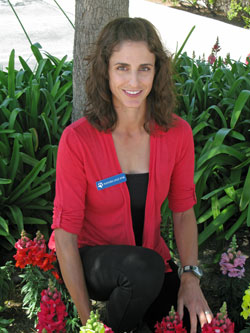
Natasha Lilly is joining the ACC team this April, 2011. She is a California native who grew up in the central valley. She first fell in love with the San Luis Obispo area as an undergraduate at Cal Poly studing Animal Science on the pre-veterinary track. In 2008, Natasha completed her DVM studies at UC Davis with an emphasis in equine medicine. She initially went to work outside of Chicago in an equine sports medicine practice. After becoming disappointed with the options to treat our atheletes, she began taking an interest into complementary medicine, especially acupuncture. She attended an equine and small animal acupuncture certification course through IVAS in 2009-2010. She was then mentored and worked for an established acupuncturist and complementary medicine DVM in Chicago, Dr. Barbara Royal. In Dr. Royalʼs small animal practice, the emphasis was on blending Western and Eastern medicine practices in treating every patient.

In addition to complementary medicine, Natashaʼs special interests include advanced imaging and nutrition. She also enjoys supporting rescue groups and humane societies and spent time doing so with the largest No-Kill shelter in Chicagoland, PAWS Chicago. She enjoys spending time with family, riding and showing her jumper, Bleu, trail riding on her ranch horse, Ben, road biking, hiking, jogging and traveling. Natasha, her husband and their one year-old son live with their 2 horses, and 2 dogs, Kona and Copper, on a ranch in Edna Valley.

Wednesday, April 13, 2011

Foxtail Season has Arrived!

Written by Marissa Greenberg, DVM

Spring seems to have arrived on the central coast!  We’ve got green hills, wildflowers blooming, beautiful weather, and longer days.  With spring comes a potentially serious hazard for our four-legged friends that we call foxtails.  Foxtails are a term we use to describe the dried up prickly plant material that likes to stick to our socks.  The problem with foxtails is that they also are very attracted to dogs and cats and they tend to only travel in one direction because of their barbs.  We commonly take foxtails out of the ears, eyes, noses, and from in between the toes of dogs, and sometimes cats.  We’ve already had our first few of the year!  It may be very green out there still, but beware the foxtails are lurking.  Because we had so much rain this year, there is a lot blooming, which means a lot that will dry out and be potential hazards for our pets.  Below is some information on the most common problems we see from foxtails

Signs that your pet may have a foxtail in their ear include a sudden onset of intense head shaking, holding their head tilted to the side, or crying out if their ear is touched.  These are all very similar signs to an ear infection, and sometimes it can be difficult to distinguish one from the other.  One of our doctors will need to look down the ears, which most pets don’t particularly like.  If there is a foxtail in an ear, often times, we need to sedate the animal to safely remove it without damaging the eardrum.

Animals that have foxtails in their eyes usually are squinting, rubbing at their eyes, and have discharge from their eyes.  Our doctors will usually put a drop of a medication that will numb the eye so that we can more easily look under the eyelids and remove any foxtails.  Often the foxtail has rubbed across the cornea, causing some damage to it, so most animals will go home with eye medications.

Foxtails that make their way up a dog’s nose can be quite frustrating! Some make it very obvious by sneezing very violently, constantly and having bloody discharge.  Others may do this initially and then stop sneezing, it can be hard to tell if they sneezed out the foxtail or if it is just lodged in a spot that isn’t bothering them enough to cause sneezing.  The doctors have a few tricks to help them try to decide if there really is something still in the nose.  Dogs will need to be sedated, and often fully anesthetized, to be able to look up their nose and remove any foxtails.  Even then, sometimes it can be very difficult to see that it has all been removed because there can be a lot of inflammation and blood up the nasal cavity.  Some dogs may have to be anesthetized a second time to look up their nose again if their symptoms don’t improve.

Long- haired dogs often get foxtails stuck in the hair between their toes, and then they like to start to burrow into their skin.  They can make some pretty yucky infections and can sometimes be difficult to find because they can migrate around through different tissues.  These patients will often need antibiotics and potential follow up visits.

So be careful when out hiking for lurking foxtails.  You may even want to feel between the toes to make sure there are none hitchhiking and to remove them before problems arise.  If you notice any of the previously mentioned symptoms with your four-legged friend, don’t hesitate to call or come by and we will come up with a plan to remove those pesky foxtails!

Tuesday, April 12, 2011

Animals In The News!

There are so many interesting news stories out there about pets and other animals, veterinary medicine or other animal related topics!  Each week we'll be gathering some stories that might be interesting to you, so keep posted each week for new stories!

This week:

Human-Animal Bond

• Losing a pet is always difficult.  No matter what kind of pets you have cared for, we can all relate to how the loss of a beloved friend affects us.  The following articles are each from a different perspective.  The first from the person who lost their pet.  The second from a veterinarian on what to consider when you are trying to decide when to say goodbye.

-"Losing a Pet - Is the Joy Worth the Pain?"

-"Pet Talk:  Is your pet suffering?"

Nutrition/Health

• A recent hot topic has been pet obesity, and it's on the rise!  Pet obesity seems to have followed along with the epidemic in human obesity.  Just as it is easier to eat fast-food that is dense with empty calories, then same goes for many pet foods and treats on the market.  Think about this, one premium pig's ear for your dog to chew on is the equivalent to 6 12-ounce Coke Classics!!  No wonder our pets are following us and adding pounds to the scale.  On the other end of the spectrum pet owners also tend to get more exercise than those people without pets.  There have been several articles in the news recently that looks further into this epidemic.

-"When Man's Best Friend is Obese"

-"Just like people, our pets are putting on weight"

-"Fat cats and plump pooches, a growing concern"

-"Fido May Help Keep You Fit"

• Your veterinarian is always the best person to consult about the best diet for your pet.  Dietary needs can change based on your pet's life-stage, and requirements will vary individually based on your pet's breed, size, activity, or  disease processes.  Here's a couple interesting articles seen lately just on diet.

-"Raw Diet or Commercial Pet Food?"

-"Little Oversight on Ingredients in 'Senior' Dog Food, Experts Say"

• If your pet is having digestive problems, the cause can vary between many different causes.  One possibility could be pancreatitis.  Pancreatitis is one of those problems that we don't know exactly everything about and can be very tricky to treat.  Causes can be anything from diet to trauma!

-"Doggy Digestive Problems? Might Be Pancreatitis"

Monday, April 11, 2011

Meet Rachel Persons! Our Featured Employee of the Week!!

Rachel joined the Animal Care Clinic team to work in various areas of the hospital in March 2011.  Rachel is a local from Atascadero and is currently pursuing a degree in Communicative Disorders.  She stays busy with her 2 dogs and spending time with her friends/family and kids.  Rachel loves outdoor activities including biking, hiking, rock climbing, and is training for her first half marathon!  Rachel is a great fit to our team with experience in a wide range of animals including dogs, cats, snakes, rats, guinea pigs, horses, swine and turtles.

Wednesday, April 6, 2011

Recco in Toronto!

Written by Stephanie Ruggerone

Airports, big city traffic and SNOW!  Such were the new experiences Recco encountered recently when he accompanied Dr. Markoff, Nicole Gunkel and myself to Toronto, Canada to attend the annual American Animal Hospital Association conference.  Animal Care Clinic was honored to be one of five finalists for the AAHA Hospital of the Year Award for 2011, so it was off to Toronto in late March while SLO was being drenched in rain.  Luckily, blizzard conditions did not strand us but we did have a few travel delays and extremely COLD conditions for soles used to the central California coast.

While Recco has been exposed to many aspects of daily life that he may encounter as a guide dog in the future, we rarely travel by air and prefer to stay a distance from both big cities and cold weather.  This trip placed him in situations he has never experienced and put lots of his prior training to the test.

We were not overly concerned with the actual air travel, though you never know what may prove overly stressful when raising a guide dog, however “ground delays” put poor Recco in a difficult situation.  Getting out of security in our wonderful SLO airport for a potty call was not a problem and so we overcame our first early morning delay easily.  Another delay in SLO put is two hours behind schedule.  Due to our first two delays, and not knowing if we were going to miss our connection, I unwisely passed the opportunity to allow Recco to relieve himself on the tarmac upon arrival at San Francisco.  What happened next?  You guessed it; we had another delay and now were stuck.  Ground delays can be minutes or hours and you don’t dare stray too far from your gate as they may ask you to board at any time!  Since Recco was acting quite comfortable I still was not too worried.  After an hour we boarded for our five and a half hour flight to Toronto.  The flight was uneventful with Recco sleeping quietly until about forty minutes out from landing.  He was restless but followed my direction to remain down under the seat.  I was relieved when we finally landed but poor Recco was in for more delay!  There was a mix up in the arriving customs terminal and no place for our plane to dock so we sat on the tarmac for another hour.  By this time I was sure Recco would never make it to the great outdoors but continued to ask him to stay down every time he made a move for the aisle.  Once we had deplaned a very nice customs agent opened a special gate for us to be processed.  Now I am smiling as I think we just might make it.  Sending the others to get my luggage, Recco and I headed for the doors only to be stopped by another customs agent wanting my declaration paperwork.  Of course there is only one declaration per family and my husband had ours over in baggage claim.  Forget trying to explain to a customs agent that your dog has not been relieved for over ten hours, they just don’t care.  I also needed to visit the ladies room but the dog must come first so I found my better half and we finally got outside.  Of course, what we found was cement and snow.  Recco has never seen snow but I took off his guide dog jacket, gave him the secret potty command and watched him for five minutes as his facial expression changed from a grimace to somewhat relaxed to thank goodness that is over! This is why we train them from small pups to relieve on leash, on command and on a variety of surfaces.  During the entire trip Recco consistently eliminated when and where I asked him too, regardless of the activity around him.

In Toronto you can last months without ever going outside in the cold!  The “PATH” is an underground system of walkways and stores that connect all of downtown Toronto.  We felt a bit like moles making our way from our hotel to the convention center the following morning.  Again Recco proved he is guide dog material as he wove through throngs of people and commotion without missing a step.  Revolving doors come in a variety of sizes, and the small ones are not conducive to big dogs with long tails.  He may not have liked the doors but he tackled them anyway, trying to keep his tail from getting caught behind him.

The classes at the convention were a piece of cake as Recco is totally accustomed to lying under a table or desk while I am working.  What proved way more difficult were the several hundred veterinary personnel who were away from their own pets for five days! We all know not to pet a guide dog when it is working but by day number five EVERYONE needed a “dog fix” and Recco’s head was beginning to swell from all the complements.  During the entire trip we only experienced one negative response to a service dog when a taxi driver at our hotel refused to allow Recco in his car.  Acceptance of these dogs has come a long way since I raised my first guide dog thirty years ago.

We are all glad to be home and there is no place better than San Luis Obispo.  Recco did amazingly well and we are proud of him and his representation of service dogs.  I think if you were to ask him he would say it was OK for a visit but he wouldn’t want to live there!

Tuesday, April 5, 2011

Animals in the News! featuring Japan

There are so many interesting news stories out there about pets and other animals, veterinary medicine or other animal related topics!  Each week we'll be gathering some stories that might be interesting to you, so keep posted each week for new stories!

This week: With the tragedy following the earthquakes and tsunami in Japan there have been many stories recently focusing on search and rescue, radiation, and ways to donate. Well below you can find it all in one place!

Check out this podcast by the AVMA with an update on the Japan disaster!

Disaster Preparedness

In light of the Japan tragedy that is ongoing many are thinking more about how they can prepare for any possible disasters.  Here in California on the central coast, earthquakes are probably on the top of the list.   Natural disasters come when we least expect them and the best way to come through safely is to be prepared ahead of time and to have an outline of a plan on what to do.  There are several resources you can look for information:

•American Veterinary Medical Association - Their website page on the Japan disaster under the news section has links for everything from disaster preparedness and emergency response guides, podcasts, videos, travel warnings, and radiation safety coming from various government sources.

•FEMA Information for Pet Owners - This web page has information on how to plan for pet disaster needs, how to prepare to shelter your pet, what to do during a disaster, and what to do after a disaster.

•AAHA HealthyPet.com - This pet owner resource has a couple of great articles with information on what questions you should be asking ahead of time and links to other resources as well as how to care for your pets during emergencies.

Places to Donate for Relief

•American Veterinary Medical Foundation - The AVMF has a Animal Disaster Relief and Response Fund.  According to the AVMF this fund is "designated to support state and national disaster relief efforts. Grants are provided for immediate disaster needs, but more importantly, to help provide training, disaster preparedness and response planning to ensure those organizations, states and or communities are disaster ready."

•Entrepreneur.com - This site had an article on "How to be Entrepreneurial with Giving."  We cannot vouch for all of the organizations listed in this article, however it mentions many different organizations that are either directly donating or collecting donations for Japan.  As always be cautious before donating to an organization you are not familiar with.

Notable News Stories


•"In a battered Japan, dogs search for human survivors" - This article talks about how many search and rescue teams traveled to Japan using dogs to find human survivors.  Many of these teams came from the United States and quite a few originally from California.

•There have been many stories on groups working to rescue animals ranging from pets to livestock to wildlife amidst the Japan disaster.  Below are some touching stories, with heart-wrenching photos and video, about working to rescue animals and the reunions that follow.

-"Rescue Operations in Japan Target the Country's Furry Friends"

-"From Porpoise to Pets, Animal Rescue Efforts Intensify"

-"Japan's pet survivors face post-tsunami struggle"

-"Helping pets in post-disaster Japan"

-"Video of Loyal Dog in Japan Reveals Canines' Social Roots"

•With the impending danger and ups and downs at the nuclear power plant in Japan, the concern over radiation exposure has been a popular news story.  Most of what we have heard is regarding radiation found in food and the worry of a radiation cloud traveling towards the United States.  In the article "Pet Owners Worried about Radiation Cloud," a UC Davis veterinarian discusses the risks to giving your pet potassium iodide tablets.

• "Joy as Dog, Owner Greet after Tsunami" - This most recent story is heart wrenching about the dog that survived for 3 weeks at sea floating on a roof!  Everyone should watch the video on this amazing story!

Monday, April 4, 2011

Meet Stephanie Ruggerone! Our Featured Employee of the Week!!

Practice Administrator, Stephanie Ruggerone, came to ACC in September 2000. She has an extensive background in many facets of animal care including behavior, training, grooming and pet assisted therapy. Following Studies in animal science and agriculture at the University of Arizona, she settled in San Luis Obispo County in 1980 after growing up in Whittier, CA. She has raised and trained Golden Retrievers under the Autumngale Obedience kennel name. After training two dogs for the county humane education program she became an animal control officer, then quickly promoted to the position of Animal Services Director. She was thrilled and honored to be invited to be a part of the Animal Care Clinic team where the emphasis is on quality animal care and client education. Stephanie and her husband have two children attending college and share their home with a true barnyard of animals. Currently there’s 1 cat, 4 dogs, 1 goat, 2 horses, 1 emu, 1 bird, and whatever shows up on the property. Her personal passion is a commitment to assist in providing guide dogs for the sight impaired. Her family has devoted many years to guide dog puppy raising, having raised 13 puppies for guide dogs. Aside from ACC and puppies, Stephanie loves to read, and all things outdoors especially hiking in Yosemite and endurance horseback riding. She has a passion for dog behavior and hopes to accomplish search and rescue training on one of her dogs and become a certified Search and Rescue team with FEMA.