Tuesday, March 8, 2011

Animals in the News

There are so many interesting news stories out there about pets and other animals, veterinary medicine or other animal related topics!  Each week we'll be gathering some stories that might be interesting to you, so keep posted each week for new stories!

This week:

"Dogs Love of Poop Turned to Scientific Good" - Scientists at the University of California at Berkeley are now using dog's ability to sniff out poop of certain animals to study wildlife!  They use this method as a non-invasive method to study wildlife!

"Which Breed is America's Top Dog?" - According to the number of dogs registered each year with the American Kennel Club (AKC) the bulldog has bumped the boxer down a notch, but the lab still remains America's number 1!  Check out this article to see where your favorite dog breed ranked!

"Young Pets Require More Than Hugs" - As spring is beginning to edge in on winter we are seeing lots of puppies and kittens.  Don't forget that these youngsters require around the clock attention.  Puppies and kittens also needs more frequent trips to the vet for vaccines and other preventive care along with training to shape wanted behaviors.

"Nearly Mailed Puppy Paired with New Owner in Minnesota" - A puppy made the headlines when a postal worker heard noises coming from a box and saved a puppy from what likely would have been a deadly ride through the U.S. postal system!

"Earth Gets Spoils of Animal Composting" - The idea of animal composting hasn't made it's way to companion pets at this time, but is gaining momentum as a green alternative to disposing of road kill and other animal carcasses!

Monday, March 7, 2011

Meet Diane Weinreich!! Our Featured Employee of the Week!

Diane has been an indispensable addition to the ACC customer service team since August 2005. Diane grew up a Navy brat, and so has lived in San Diego, Monterey, England, Nebraska, and Maryland.  She graduated from Cal Poly with a B.S. in Animal Science in 1985. Diane is married to her husband Eric, with whom she shares 4 teenage children, 1 cat and 2 dogs. Her athletic family keeps her very busy running from one sporting event to another! She also loves sports (it’s a good thing!) and any creative outlet, especially music, photography, and arts & crafts.

Thursday, March 3, 2011

Demodex Mites: What are they and ways to treat

Written by Bonnie Markoff, DVM, ABVP

Pamela has asked Animal Care Clinic if there is any treatment for Demodex besides a product called Promeris. The answer is a definite "yes!"


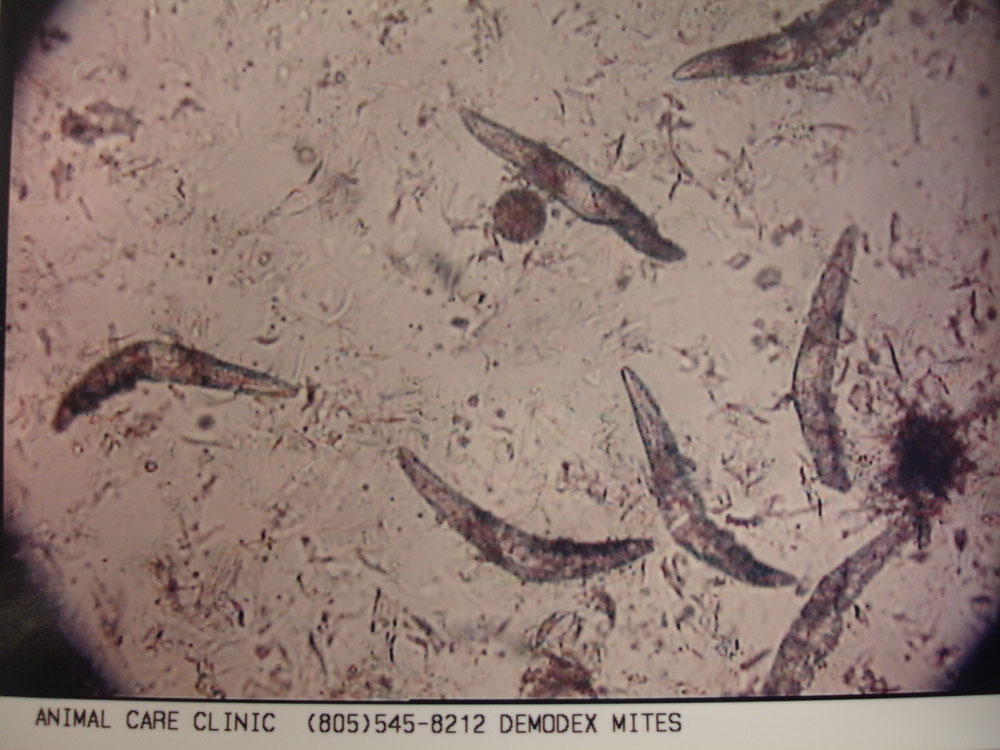
Demodex mites viewed through a microscope.

Let's start by looking at what Demodex is. Demodex mites are microscopic insect-like creatures that normally live on the skin of many dogs and cats. If the immune system is compromised in any way, they can rise in numbers and cause skin inflammation. This is most commonly seen in puppies as focal areas of hair loss and scaling. Sometimes we see lesions all over the body and occasionally adult dogs and cats will have chronic recurring trouble with skin infections due to demodex mites.

Treatment depends on the severity of the problem and the age of the pet. Puppies with only one or two small lesions in a limited area of the body may need no treatment at all. We use antibiotics to treat secondary infections and watch the areas to be sure they regress on their own. Adults, youngsters with many lesions and cases where lesions are not regressing will require specific mite therapy. This can take the form of topical dips or rinses, injectable or oral medications, or one of the topical "flea control" products.

For very localized lesions, particularly in young dogs, I like to use a product called Mitaban, which contains Amitraz. This dip is pretty obnoxious to use on an entire animal, and is toxic to cats, but it is an easy and inexpensive way to gain control of mild, local disease. For more extensive cases, we have classically used a deworming medication called ivermectin. This product can be injected or taken orally. It is usually very effective, but can have side effects. We usually start it at a low dose and slowly raise the dose while looking for any drug intolerance. Collies, Border Collies and similar breeds are more likely to have adverse reactions to the drug. If this product works quickly and is tolerated by your pet, it is usually quite cost effective. Promeris is one of the newer topical flea products and it has been shown to have good efficacy against Demodex. There is no currently agreed upon best method for using this product for Demodex. It is usually applied every 2-4 weeks and may be needed lifelong. Most veterinary dermatologists prefer ivermectin for treating demodex.

The most important thing to know when trying to clear demodex is that every patient will be different. It is absolutely essential to monitor the disease regularly. Skin scrapings should be performed every 1-4 weeks and it is important to count the mites with each scraping. You should hear a live vs. dead mite count each time your dog is seen by your veterinarian. This is what tells us if the treatment is effective and guides us in how long to continue the therapy. Many adult dogs will need therapy for their entire lives to control this disease.

If you have any questions about mites, skin disease or other veterinary issues, call us at Animal Care Clinic. We are open M-F 7:30-6, Saturdays 9-3 and Mondays until 8pm.

Wednesday, March 2, 2011

PetsMatter Newsletter March/April 2011

PetsMatter Newsletter is written by the American Animal Hospital Association with a dose of pet health, behavior and lifestyle articles from veterinary professionals. Articles featured in this issue include:

•Expert Explores Unexplained Animal Behavior

•Bringing a New Kitten Home

•Cats Get Arthritis Too

•I Want to Be a Veterinarian When I Grow Up

•Does the Carpet Match My Dog? Pet-Friendly Amenities Attract Home Buyers

Check out the full newsletter and links to this issue's articles on HealthyPet.com!

Tuesday, March 1, 2011

Pets Sleeping In Your Bed

Dr. Michael Cavanaugh, AAHA Executive Director, responds to a recent article that highlights the risks of letting your pets sleep in your bed. Original article from MSNBC can be found at http://www.msnbc.msn.com/id/41235440/ns/health-pet_health/.

We think this video sums up our opinion on this story pretty well.  There are some risks of pet ownership as far as zoonotic diseases (diseases transmissible between people and animals) go, and this is our job as veterinarians to educate pet owners about.  Several team members of Animal Care Clinic share their bed with their pets and this recent article will not change this.  As long as pets are current on their preventive care there is a very low risk for anything to be passed.  Common sense of doing things like washing hands will go a long ways in keeping everyone healthy!  So keep enjoying the comfort and companionship of your pets and let us know if you have any questions about your pet's preventive care!

Monday, February 28, 2011

Meet Eileen O’Neill-Hitch!! Our Featured Employee of the Week!

Eileen started at Animal Care Clinic as a veterinary nurse in April 2004. In November of 2008, Eileen moved up front to Customer Service and has been there ever since. Originally from the East Coast, Eileen has lived most of her life in California so she considers herself a “California Girl.” Eileen previously worked as a technical writer in Silicon Valley for 20 years, so this is her second career. She loves working with animals and says, “You’re never too old to keep on learning and growing. You CAN teach an old dog new tricks – they proved it on Myth Busters!” In her spare time, Eileen enjoys reading, knitting, and hiking. Eileen and her husband are also employed as staff by their cats.

Wednesday, February 23, 2011

How To Brush Your Dog's Teeth

Just like people, dogs and cats are recommended to get their teeth brushed as a part of their preventive care regimen. Teeth brushing should occur a minimum of 5 days a week to be beneficial. Use a child size soft bristled tooth brush and dog/cat formulated enzymatic toothpaste. Watch this video for some helpful tips in making brushing your pet's teeth an easy and fun process. Come by Animal Care Clinic or give us a call at 805-545-8212 for questions or to schedule a tooth brushing demonstration!