Thursday, February 3, 2011

KSBY Central Coast Experts – Feeding Pets

Written by Bonnie Markoff, DVM, ABVP

Many clients at Animal Care Clinic ask about how to feed their pets - free choice or meals. Veterinarians disagree to some extent as which is better, and there are medical benefits to both systems.Many owners find it convenient to leave food out all the time for their animals, especially cats. Others prefer to put a set amount of food down for a few minutes and let the pets eat what they want, and then put the food away. At Animal Care Clinic we have found that pets who are given free choice to food are more often overweight, and that it can be extremely difficult to get a pet to lose weight without using meal feeding as a strategy.

We strongly recommend that you start all puppies and kittens on meals from the very beginning. This can help greatly with potty training. Animals 7-16 weeks of age should get at least 3 meals a day. Once they reach 4 months of age you can cut back to two meals daily and continue this throughout adulthood. By starting meals when pets are young you can prevent obesity. Feeding your pets to their proper lean body weight can add 2 years to their lives!

But what do you do if you want to make a habituated free choice feeder accept meals? Every animal will respond to this differently. Dogs who know how to manipulate their owners (that would be most dogs!) will follow you around, whine a little and then flash those big, brown eyes and make you feel really guilty. Do not cave in! Most pets are not "always hungry" - they are "always bored." When you are watching TV and feel like getting a snack, is it because you are hungry or because you like to have a snack while you watch TV? Very few Americans (pets or people) get truly hungry before meals. So.....in most cases, you can just start feeding meals: set down the food bowl, wait 30 minutes and then pick it up. Don't put it down again until dinnertime.

Cats and some dogs present a bigger challenge. Cats deprived of food at night have been known to jump into the owner's bed and attack! Some pets pester us so badly that we just can't relax or function in our homes without appeasing the pet's demands. In these cases we have to be more subtle. Start picking up the food in the middle of the day - just for an hour or two. Your pets probably won't even notice. Each week add 30 minutes to the time the food is unavailable. If you will be out of the house, pick up the food for the entire time (your pets can't retaliate when you are not home.) Try picking up the food just as you go to bed and set it back down when you wake up. By gradually extending the times that the food is unavailable, you will eventually get to the point where food is available for only 30 minutes, twice a day. My dogs & cat eat their meals in less than 5 minutes.

It is also important to have a separate bowl for each pet. We must prevent the gluttons from eating food out of the bowls of their friends. Supervised meals can help with this. Sometimes we must separate pets into different rooms during mealtime.

By feeding meals and using a separate bowl for each pet, you will be ready to conquer almost all nutritional problems. Weight loss is much easier for animals on this regimen. It is much easier to change diets for pets who eat meals. It is also easier to hide medications in the food of pets who eat meals because they tend to eat faster. (Now, eating too fast is an entirely separate subject!)

For more nutritional tips call us at 545-8212.

Tuesday, February 1, 2011

Special Needs Companions


Stephanie and Red Fred

Written by Stephanie Ruggerone, Practice Administrator

In the movie “Seabiscuit”, trainer Tom Smith states, “You don’t throw a whole life away just because it’s banged up a little”.  Oh how I wish more people would view the world this way!  While I have loved many animals in my life, it is the ones who had “special needs” that have taught me the most valuable lessons.

Our animal companions do not feel sorry for themselves nor do they expect special treatment.  Regardless of the origin of their “defects”, by birth, illness or injury; they forge ahead with life and find ways to overcome disability.  They possess the same devotion and love as normal animals but we often discard them because they don’t look right or require a little extra care on our part.  While some of these wonderful creatures may require additional financial means, most simply need someone to accept them as they are and allow them to burrow into a human heart.

Blind animals can quickly learn to navigate a home and yard and enjoy leashed excursions once they know you will be their “guide human”.  They compensate for their lack of sight tactility and with sound.  Keeping a radio playing in a specific part of the home or hearing a water fountain gives them points of reference.

Deaf pets can learn hand signals and feel vibrations.  Oh, but how do you get their attention to teach the signals?  Use the nose!  Food will keep their attention for quite some time.  They often learn to “check in” with their human friends by frequently turning to look for signals.  Yes, it takes some additional time to ensure these animals are safe in their environment but well worth the effort!

Missing body parts often seem to be a big factor for us but rarely a problem for the animal.  We often fail to look beyond the appearance and can’t imagine these animals being happy.   With proper exercise they can frequently run like the wind, keeping up with their full-bodied friends.  Some even excel in agility!

Napoleon is one of my current special needs “kids”.  He was born with a syndrome called “swimmer puppy” and his future was questionable.  He learned to walk (and run) through he isn’t exactly graceful and he is absolutely wonderful with my two year old grand daughter.  He has given my family seven years of snuggles, smiles and lots of laughs.  He may not be “normal” but has endless value to me via unconditional love.

Never thought of adopting a special needs pet?  Try it! I think you may find you not only like it but it may become habit forming.

Monday, January 31, 2011

Meet Nicole Haug! Our Featured Employee of the Week!!

Nicole joined the customer service team in September of 2009.  She is a local San Luis Obispan and currently attending Cal Poly, majoring in Sciology.  Nicole loves to spend time and hike with her 3 dogs Brixtyn, Ginger and Bear and also has a Beta fish at home, Fishy.  Other hobbies are going to the movies and gym, reading, and spending time with her family, friends, and boyfriend.

Tuesday, January 25, 2011

What is ABVP?

Written by Marissa Greenberg, DVM

Most people are familiar with  the usual specialties like internal medicine, surgery,  or radiology.  But what does it mean for a veterinarian to be a boarded practitioner, a member of ABVP?  The American Board of Veterinary Practitioners is a unique specialty and can be described as being a "specialized" general practitioner.
ABVP was established in 1978 to promote excellence in general practice.  In contrast to the other specialties that focus on a specific system, ABVP promotes care of the “total patient.”   ABVP offers certification in 8 different fields, or practice categories: avian, beef cattle,  dairy cattle, canine and feline, equine, feline, food animal, and swine health.  ABVP doesn’t require a residency program.  Veterinarians can work towards this specialty status while in practice.  In fact, they must be in practice, working on their species of choice for at least 6 years, before certification can be pursued if a residency program was not completed.  It allows for practical, on-the-job training for the goals to be reached.


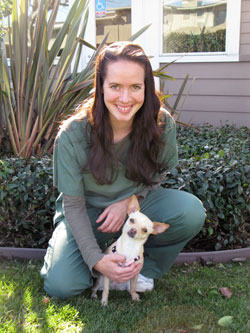
Bonnie Markoff, DVM, ABVP

After 6 years of practice, an applicant must submit a curriculum vitae, a synopsis of their veterinary experience post-graduation, a self-report job evaluation form, 3 applicant evaluations, 2 case reports, and proof of 90 hours of Continuing Education over a 5 year period.  The application is reviewed by members of the board.  The 2 case reports are meant for the applicant to demonstrate their expertise and their high quality practice abilities, and are based on cases the applicant has seen over a 5 year period.  Once the application is approved by the board, applicants can sit for their qualifying exams.  For each specialty area (except swine) there are two exams.  The specialty exam is generally a 300 question multiple choice exam designed to test the applicant’s knowledge in their chosen practice category.  The practical portion of the exam varies by practice category.  Both tests must be passed in order to achieve certification.  The tests for all specialty fields are given at the same time and same place each year, November in Chicago.


Marissa Greenberg, DVM

Once certified, the ABVP promotes self-improvement.  It is the only veterinary specialty that requires recertification, which is required every 10 years.  Recertification can be reached by a variety of methods, which includes published papers, Continuing Education,  and examination, amongst others.  By requiring recertification, ABVP members demonstrate that competency and quality of practice has been maintained.
ABVP describes their diplomates as “exceptionally talented veterinarians who reach beyond the expected and embrace challenges, because it is their passion.”  Our own Dr. Markoff embraces this, and has been an ABVP diplomate since 1994.  She is the only ABVP diplomate between Buelton and the bay area.  Dr. Markoff will be my mentor as I embark on the road to becoming an ABVP diplomate myself.  I will be working on my case reports and hope to receive my board certification by 2015.  We’ll keep you posted!

Monday, January 24, 2011

Meet Louise Facciola! Our Featured Employee of the Week!!

Louise graduated from Cal Poly with her Animal Science degree in 2005 with a minor in Equine Science. She began working on the veterinary nursing team at Animal Care Clinic in November 2008. Louise came to San Luis Obispo from Loyalton, California. She would like to obtain her registered veterinary technician license in the future. In her spare time, Louise enjoys riding her horse, running, hiking, playing with her cat, Remington, and taking her dog, Avila to the beach.

Thursday, January 20, 2011

Caring for Feral Cats - KSBY Local Experts Question

Here's an answer posted by Dr. Markoff in response to a question posted on our KSBY Central Coast Experts page.

Written by Bonnie Markoff, DVM, ABVP

Janice has asked about a feral cat named Heckel who has something wrong with her lower jaw.  Caring for feral or “wild” cats can be extremely frustrating.  We find cat colonies developing in many areas in our county.   Quite often, a Good Samaritan feeds the cats, but usually the cats will not allow human contact.  This means that providing medical care, including vaccines, requires trapping the cats.   Illness in these colonies can be very distressing.

Feral Cats
It can be very difficult to decide whether or not to trap and care for a feral cat.  The process of trapping is very stressful for the cat.  Handling the animals can be dangerous for the people involved.  Follow-up care such as daily medications or suture removal, can be nearly impossible.  Many people believe we should treat cat colonies like wild populations – no human intervention and allow “nature to take its course.”  But those who feed and watch over these cats develop relationships with them and cannot bear to watch them suffer.

The cat I referenced above had been trapped in order to be spayed, and then released back into the colony.  She now is drooling and there is a green color to the drool.  If Janice gives her antibiotics (I assume being put into food or water), the problem improves greatly, but is back within just a few days when the medication is stopped.  Janice has asked if it safe to give antibiotics daily forever.  In this particular situation, I think it may be the best choice we have.

Normally we try to avoid the long-term use of antibiotics.  We rarely see significant side effects from the antibiotics and quite often they effectively fight the infection for years.  However, on occasion we can see “bad” microbes take over in the body. Women may develop vaginal yeast infections, which is not a significant problem for our pets.  Instead we can see a change in the bacteria in the intestinal tract, which can lead to diarrhea and other GI upset.  We can also see the development of bacteria that are resistant to the antibiotic we are using.  This can lead to superinfections that are hard to treat.

I am concerned that Heckel has either traumatized her jaw or has a tooth abscess or tumor in her mouth.   If we were to trap her, treatment may be very extensive, which would not only be costly, but very stressful for Heckel.  There would be a high likelihood that she would need to stay in the hospital for follow-up care, adding to Heckel’s stress.  If daily antibiotics are helpful, that may be the most humane thing to do.  It is unlikely that lifelong daily antibiotics will be harmful to Heckel.  So Janice, go ahead with daily Fishmox and we wish you the best of luck.  Let us know if we can be of further help.

Basic Manners - KSBY Local Experts Question


By Bonnie Markoff, DVM, ABVP

We have had several questions related to pet behavior on our KSBY Local Experts page.  Pet owners have concerns about barking, biting, scratching, jumping, destructive behavior, animals getting into things, basic training and boundary training.  Most of these problems stem from trying to bring an animal into our civilized homes.  Our expectations may seem unreasonable to our canine & feline friends.  Expecting your dog to stay away from yummy items in a trashcan is similar to asking Aunt Norma to not partake in the dinner you set before her.

When we bring animals into our homes, we must remember that barking, digging, searching out good food and being an intimate part of a group are all natural behaviors.  Luckily, dogs and cats are very trainable and can learn to be civilized members of the team.  If we start when they are young, training is usually quite easy.  We set boundaries, remain consistent in enforcing these boundaries and gently provide alternatives.  If you do not want adult animals on your couch or bed, you must not let them on the furniture when they are young.  In fact, you must make it impossible for them to access the furniture until they learn the rules.  This may mean confinement to a crate or other area of the house.   Puppies who jump up need to learn that they will NEVER earn physical contact or praise when they are jumping up.  They should be taught to sit and stay so that when they jump up we can tell them to sit and then give loads of praise for this alternative behavior.

Some behaviors that we find extremely disruptive are important survival instincts and can be very hard to eliminate from certain pets.  Dogs who get into the trash or eat things off the counter, often never learn otherwise.  These can be situations where we need to put things away immediately and keep our trashcans in places the dogs cannot access.  Cats who urine mark territory, can be equally frustrating.  Early spay and neuter may prevent this.  Sometimes we can use medications or pheromones to prevent the behavior.  Barking is sometimes extinguished by keeping dogs where they cannot see or hear any outside stimulus (i.e. indoors with the TV on.)  Some dogs will require a bark collar.  I do not like the use of shock collars, but find the citronella collars to be effective in many situations.  Cats that scratch furniture can often be trained to stop if given acceptable alternatives.

Good training and behavior modification can be complicated.  Programs should be individualized to each family and pet.  Some dog trainers are very good with these types of interventions.  In some cases, a veterinarian with a special interest in behavior will be required.  At Animal Care Clinic, our Dr. Jennifer Evans can help with most behavior concerns.  We can also provide referrals to good local dog trainers.