Tuesday, January 11, 2011

Specialty Surgery at Animal Care Clinic

Written by Marissa Greenberg, DVM

As general practitioners at Animal Care Clinic, we all perform surgeries like spays and neuters.  Sometimes we do more extensive surgeries like taking out a spleen (called a splenectomy), taking out bladder stones, or removing an object from the gastrointestinal tract that a patient shouldn’t have eaten!  But sometimes there are surgeries that are better left to the hands of a Diplomate of the American College of Veterinary Surgeons (DACVS).  We generally refer to these veterinarians as “boarded surgeons.”  This means that they have gone through at least 4 more years of training after vet school, honing their surgery skills.  They then must publish articles and take a test to become a boarded surgeon. 

At Animal Care Clinic, we are fortunate to have a working relationship with Dr. Greg Marsolais, MS, DVM, DACVS.  Dr. Marsolais worked at Animal Care Clinic as a veterinary nursing assistant while he was a pre-vet student at Cal Poly.  He then went on to receive his DVM and Master of Science Degree from Iowa State University.  He did his surgical residency at the University of Illinois.  He now runs his own practice called Pet Surgeons, Inc.  He travels to clinics to provide consultations and perform surgeries.  Because of his previous relationship with Animal Care Clinic, we are happy to be able to have him visit us to perform these services for our clients and patients. 

Dr. Marsolais is generally at Animal Care Clinic at least once a month.  He spends his morning doing consultations and meeting the clients whose pets are to have surgery that day.  One of our Animal Care Clinic doctors are always involved with each case to be sure that we are in the know and can follow through once Dr. Marsolais leaves for the day.  Our Animal Care Clinic doctor works with Dr. Marsolais to create an anesthesia and pain management plan for each patient that is having surgery.  Our staff monitors anesthesia for his surgeries just as they do for all of the surgeries our doctors perform.  Many of the surgeries that Dr. Marsolais performs are orthopedic procedures, but he does many others as well. 

Most of Dr. Marsolais surgeries spend at least one night in the hospital.  This is so that our staff can monitor the patient’s vital signs and control any post-operative pain.  We discourage owners from visiting patients post-operatively because it often excites them too much, and they can become very distressed when their owner leaves.  This can put patients at risk for post-operative complications.   Patients are generally discharged with very specific post -operative instructions and medications, and our doctors are always able to contact Dr. Marsolais regarding his cases for further follow-up. 

If your pet has any issues that you think may warrant a consultation with Dr. Marsolais, please contact us so we can help schedule an appointment!  

Monday, January 10, 2011

Meet Cate Morris! Our Featured Employee of the Week!!

Caitlin goes by Cate here at ACC, and has been a part of the Customer Service Team since November 2007. Cate grew up in rural Mc Arthur located in Northern California. She is married to Travis of our nursing team and has two children, her stepson Skyler and daughter Hailey. Cate loves hiking, tide pooling and spending time with her family.

Thursday, January 6, 2011

Matted Fur - KSBY Local Experts Question

By Bonnie Markoff, DVM

Thank you, Shawna for your question about grooming Persian cats. This can be a big problem for many cat owners! The fine hair of a Persian easily clumps together to form matts – those Rastafarian type clumps of fur that cannot be broken up with a brush. Matts can be very painful and even cause damage to the skin because they pull on the skin like an over-tight ponytail. Many animals resent any effort we make to remove the matts, and it seems that Persian cats have the most pain associated with the procedure.


To remove matts that are not painful, try a brush designed specifically for that purpose. These brushes actually have sharp edges that cut through the matt. Once you break the matt into smaller parts, it is less painful and easier to remove. In some instances, you may be able to cut them off with scissors – BUT BE CAREFUL!! It is extremely easy to cut the skin. Never pull up on a matt and cut below it. The process of pulling up on the matt will tent the skin and almost guarantee your scissors will cut your pet. Electric clippers are usually the best way to remove the matts. Groomers can often do this. If the process is painful or your pet just hates being groomed, we may need to sedate your pet for the treatment. Shawna, you quoted a very high dollar amount for this procedure. Our hospital should be able to help you for about half that price, maybe less on subsequent visits.

Prevention is the best way to manage matts. Animals who are prone to matting their fur should be brushed every day with a good rake type brush. If you find any small matts while brushing, remove them with a matt rake or scissors when they are small and not painful. Some animals benefit from removing the hair that typically matts. A groomer can keep the hair in these areas clipped short or even shaved down to the skin. It is usually much easier to clip the hair short before matts develop than to remove the matts later. I hope this helps, Shawna!

Tuesday, January 4, 2011

Cat and Dog Buds


Written by Jennifer Evans, DVM

We’ve all heard the saying ‘fighting like cats and dogs’ but sometimes cats and dogs can be the best of friends!!  If raised together, dogs and cats are often great buddies; playing, sleeping and even eating together.  There is something quite profound about seeing a large pit bull snuggled up with a cat, they should be enemies yet they aren’t.  Kind of makes you wonder what we should be capable of as a ‘more intelligent’ species! 

Baldwin (cat) and Bean (dog)

While it’s true that some dogs just simply can’t safely be around cats, many can be taught appropriate ‘cat manners.’  The easiest way to start integrating the two species is either with a youngster of each or with an adult dog or cat that is used to the other species and a youngster who doesn’t know they should be afraid.  An adult cat that runs unfortunately becomes a really fun game for a puppy and can actually become ‘prey’ for adult dogs that don’t know better.   Whenever introducing the two, always have the dog under control with a leash and have the cat’s nails trimmed.  See how they do and progress from there.  Keeping the cat in a crate for short training periods and rewarding the dog when he ignores the cat or possibly squirting him with water if he’s too fixated will sometimes help an adult dog learn how to peacefully co-exist with a cat.  Always be cautious when introducing new critters to each other and never leave them alone unsupervised until they have proven they can get along safely.   Sometimes it takes a while for them to become friends. 

Rocky (cat) and Petey (dog)
Our office manager Lavella adopted her “chiweenie” from the shelter months ago and it took a while for her cat ‘Rocky’ to accept the new addition, but in time he realized the benefits of having another four-legged buddy in the house.  The rewards of having a dog and cat that love each other are quite numerous, not the least of which includes really awesome photo ops! 

Tuesday, December 28, 2010

Winter Dog Activities

Slink playing in the snow.
Written by Marissa Greenberg, DVM

Though it hasn’t felt like it lately, winter is here!  As you plan any trips this winter, consider including your dog if you are going to the snow!  Most dogs seem to take to the snow naturally, and just love playing in it!  When I moved to Washington with my dog Slink, she had never experienced the snow.  But she instantly loved it and enjoyed running through it, looking for things to chase underneath it, and trying to catch snowballs! There seems to be something about it that just energizes some dogs.  The first time Mico went, he instantly loved it as much as Slink!

River wearing her winter jacket.
There are several activities you can do with your dog at the snow.  The first is just playing in it! Letting them run, play, try to catch or find snowballs, and digging through it can be very entertaining for all involved.  There are many places you can take dogs with you on trails where you can snowshoe or cross country ski.  It is important to make sure that your dog is comfortable in the cold weather-some may need sweaters or jackets if they are short haired breeds.  If running around a lot in the snow, your dog may need booties to protect their pads.  Also, make sure they have a water source that isn’t frozen over and that they have a warm place to sleep.

River jumping to catch snowballs.

Skijoring
For the real snowy condition enthusiasts, you may want to try your hand at skijoring.  Skijoring is where a dog or pair of dogs are harnessed and connected to a skier, thus pulling the skier along the trails.  Any medium to large sized dog could enjoy this sport!  The other dog snow sport is of course, dog sledding.  If you are interested in more information about either of these sports, please check out this website http://www.psdsa.org/Default.aspx

We would love to see pictures of you and your pets out enjoying the snow! Have fun out there enjoying winter wonderlands of snow with your pets!

Monday, December 27, 2010

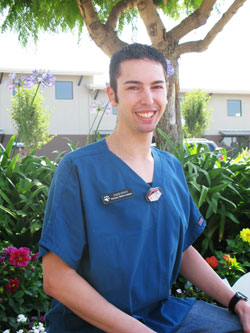
Meet Zack Stout!! Our Featured Employee of the Week!


Zack joined the veterinary nursing team in July 2008. Originally from Bakersfield, Zack moved to San Luis Obispo to attend Cal Poly. He is an Animal Science major and would like to attend vet school some day. Zack is interested in most physical activities and it is very likely to come across him playing volleyball at Pismo Beach. 

Wednesday, December 22, 2010

Spay and Neuter Commercial

Spaying and neutering can provide tremendous health benefits to your dog and cat. If you choose to breed a pet, be sure you understand the responsibilities this entails. Dogs and cats should be screened for genetic diseases and sound reproductive health before breeding. And you need to be sure you can provide good homes for all of the offspring. Contact Animal Care Clinic for more information on canine and feline reproduction and on the benefits of spaying and neutering your pets.